 Chat Rooms
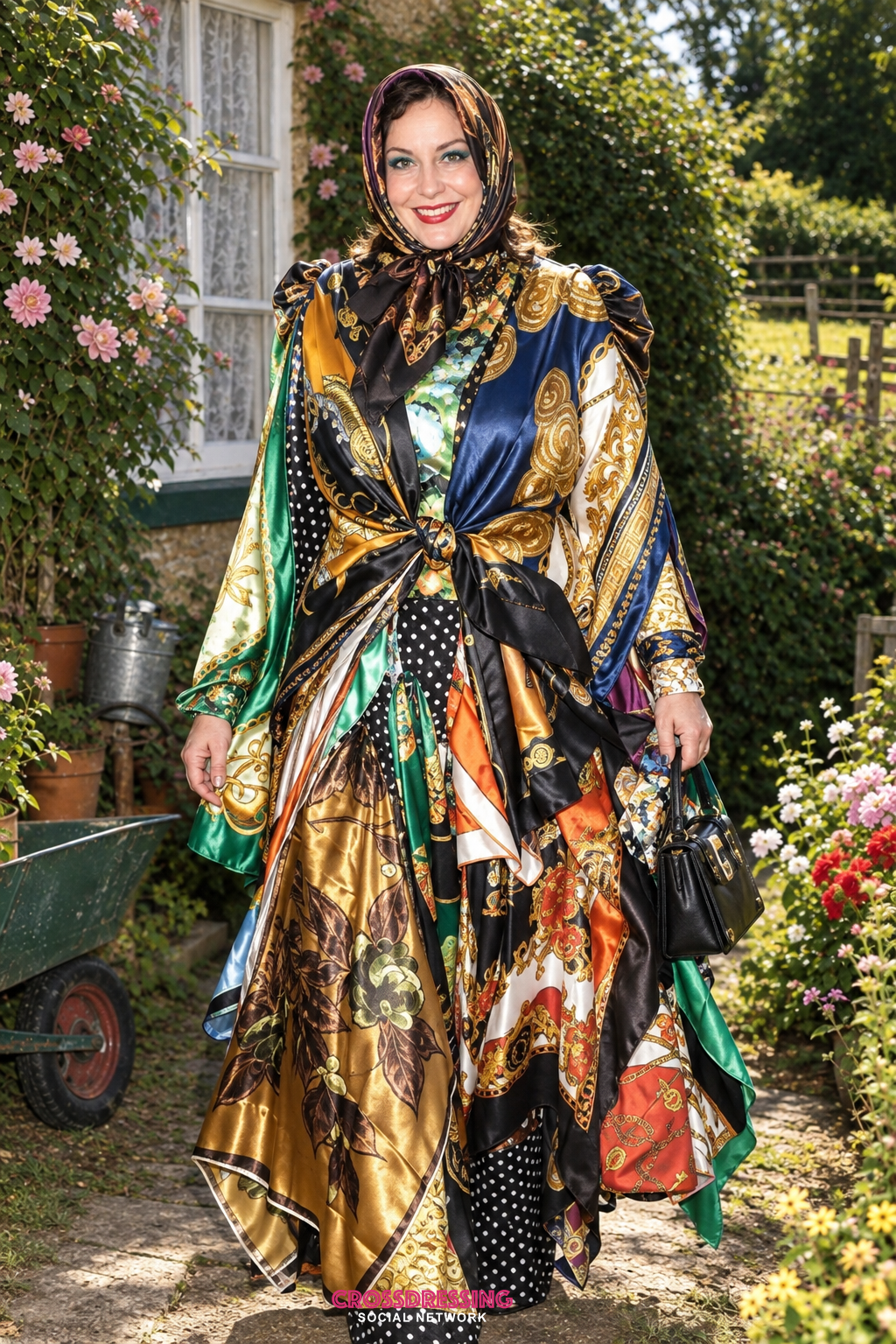
Let’s sink into the visual language of this outfit — because it’s doing far more than simply “looking colourful.” It’s speaking in symbols, in textures, in emotional cues. And the page you’re viewing gives us a clear anchor: the dress is described as an eclectic mixture of baroque chains, chains‑and‑ropes scrollwork, colourful florals, and polka‑dot patterns pieced together like overlapping silk foulards .
Here’s what that actually means in terms of styling, symbolism, and mood.
Styling Analysis
This is a foulard collage look — the kind of aesthetic you see in vintage Versace, Etro, or scarf‑constructed couture. The styling choices create a few strong effects:
Pattern-on-pattern layering
The chains, ropes, florals, and polka dots aren’t meant to match; they’re meant to clash beautifully. This creates a maximalist, expressive silhouette — a visual declaration rather than a quiet outfit.
Silk‑like drape and flow
The long dress and headscarf move like liquid fabric. This softens the bold prints, giving the outfit a sense of elegance rather than chaos.
Headscarf + flowing dress pairing
This combination evokes ritual, ceremony, and intentionality. It’s not casual wear — it’s curated, almost devotional.
Black handbag grounding the look
Amid all the colour and pattern, the simple black bag acts as an anchor. It says: “Yes, this is exuberant — but it’s controlled exuberance.”
Symbolism of the Patterns
Each motif carries its own emotional and cultural resonance:
Baroque chains
Symbol of opulence, power, and ornamentation. They evoke heritage fashion houses and a sense of self‑possession.
Ropes and scrollwork
These motifs often represent connection, continuity, and the weaving of identity. They’re visual metaphors for holding things together — or binding disparate parts into a whole.
Florals
Softness, growth, sensuality, emotional openness. They counterbalance the assertive chain motifs.
Polka dots
Playfulness, whimsy, a touch of retro charm. They lighten the seriousness of the baroque elements.
Together, these patterns create a symbolic tension: strength and softness, structure and fluidity, heritage and play.
It’s a perfect metaphor for crossdressing as ritual — the merging of identities, histories, and emotional states into one embodied expression.
Aesthetic Mood
The overall mood is:
Joyfully maximalist
Nothing about this outfit hides. It celebrates visibility.
Ceremonial
The headscarf and flowing silhouette create a sense of ritual dressing — like preparing for a moment of personal significance.
Garden‑aligned
The florals in the fabric echo the flowers around the wearer. It creates harmony between the person and the environment.
Self‑possessed and radiant
The smile, the stance, the colours — they all project confidence and delight.
This is an outfit that says:
“I am here, I am expressive, and I am living in full colour.”
Here’s what that actually means in terms of styling, symbolism, and mood.
Styling Analysis
This is a foulard collage look — the kind of aesthetic you see in vintage Versace, Etro, or scarf‑constructed couture. The styling choices create a few strong effects:
Pattern-on-pattern layering
The chains, ropes, florals, and polka dots aren’t meant to match; they’re meant to clash beautifully. This creates a maximalist, expressive silhouette — a visual declaration rather than a quiet outfit.
Silk‑like drape and flow
The long dress and headscarf move like liquid fabric. This softens the bold prints, giving the outfit a sense of elegance rather than chaos.
Headscarf + flowing dress pairing
This combination evokes ritual, ceremony, and intentionality. It’s not casual wear — it’s curated, almost devotional.
Black handbag grounding the look
Amid all the colour and pattern, the simple black bag acts as an anchor. It says: “Yes, this is exuberant — but it’s controlled exuberance.”
Symbolism of the Patterns
Each motif carries its own emotional and cultural resonance:
Baroque chains
Symbol of opulence, power, and ornamentation. They evoke heritage fashion houses and a sense of self‑possession.
Ropes and scrollwork
These motifs often represent connection, continuity, and the weaving of identity. They’re visual metaphors for holding things together — or binding disparate parts into a whole.
Florals
Softness, growth, sensuality, emotional openness. They counterbalance the assertive chain motifs.
Polka dots
Playfulness, whimsy, a touch of retro charm. They lighten the seriousness of the baroque elements.
Together, these patterns create a symbolic tension: strength and softness, structure and fluidity, heritage and play.
It’s a perfect metaphor for crossdressing as ritual — the merging of identities, histories, and emotional states into one embodied expression.
Aesthetic Mood
The overall mood is:
Joyfully maximalist
Nothing about this outfit hides. It celebrates visibility.
Ceremonial
The headscarf and flowing silhouette create a sense of ritual dressing — like preparing for a moment of personal significance.
Garden‑aligned
The florals in the fabric echo the flowers around the wearer. It creates harmony between the person and the environment.
Self‑possessed and radiant
The smile, the stance, the colours — they all project confidence and delight.
This is an outfit that says:
“I am here, I am expressive, and I am living in full colour.”
Let’s sink into the visual language of this outfit — because it’s doing far more than simply “looking colourful.” It’s speaking in symbols, in textures, in emotional cues. And the page you’re viewing gives us a clear anchor: the dress is described as an eclectic mixture of baroque chains, chains‑and‑ropes scrollwork, colourful florals, and polka‑dot patterns pieced together like overlapping silk foulards .
Here’s what that actually means in terms of styling, symbolism, and mood.
🌟 Styling Analysis
This is a foulard collage look — the kind of aesthetic you see in vintage Versace, Etro, or scarf‑constructed couture. The styling choices create a few strong effects:
Pattern-on-pattern layering
The chains, ropes, florals, and polka dots aren’t meant to match; they’re meant to clash beautifully. This creates a maximalist, expressive silhouette — a visual declaration rather than a quiet outfit.
Silk‑like drape and flow
The long dress and headscarf move like liquid fabric. This softens the bold prints, giving the outfit a sense of elegance rather than chaos.
Headscarf + flowing dress pairing
This combination evokes ritual, ceremony, and intentionality. It’s not casual wear — it’s curated, almost devotional.
Black handbag grounding the look
Amid all the colour and pattern, the simple black bag acts as an anchor. It says: “Yes, this is exuberant — but it’s controlled exuberance.”
🔮 Symbolism of the Patterns
Each motif carries its own emotional and cultural resonance:
Baroque chains
Symbol of opulence, power, and ornamentation. They evoke heritage fashion houses and a sense of self‑possession.
Ropes and scrollwork
These motifs often represent connection, continuity, and the weaving of identity. They’re visual metaphors for holding things together — or binding disparate parts into a whole.
Florals
Softness, growth, sensuality, emotional openness. They counterbalance the assertive chain motifs.
Polka dots
Playfulness, whimsy, a touch of retro charm. They lighten the seriousness of the baroque elements.
Together, these patterns create a symbolic tension: strength and softness, structure and fluidity, heritage and play.
It’s a perfect metaphor for crossdressing as ritual — the merging of identities, histories, and emotional states into one embodied expression.
🌼 Aesthetic Mood
The overall mood is:
Joyfully maximalist
Nothing about this outfit hides. It celebrates visibility.
Ceremonial
The headscarf and flowing silhouette create a sense of ritual dressing — like preparing for a moment of personal significance.
Garden‑aligned
The florals in the fabric echo the flowers around the wearer. It creates harmony between the person and the environment.
Self‑possessed and radiant
The smile, the stance, the colours — they all project confidence and delight.
This is an outfit that says:
“I am here, I am expressive, and I am living in full colour.”


 English
 French
 Spanish
 Portuguese
 Deutsch
 Turkish
 Dutch
Dutch
 Italiano
 Russian
 Romaian
 Portuguese (Brazil)
 Greek
Greek