


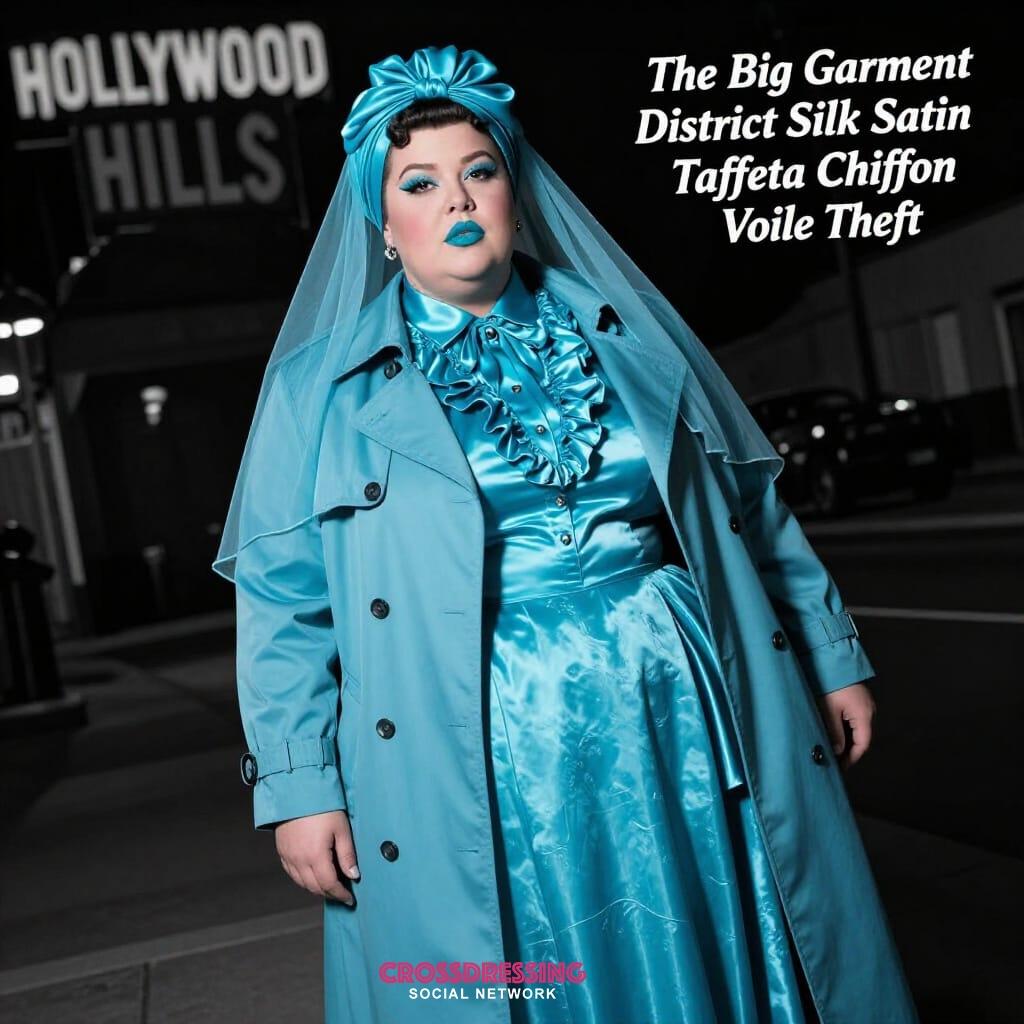
In the Hills after the Bomb they mostly call me The Late Detective. Late to justice, late to lunch, late to the end of the world. The sky was the colour of an old television left on after the station died, tilted at a Dutch angle like God had nudged the tripod and walked away. In this town, fabric tells the truth faster than people. I walked through it swaddled in turquoise satin, layered, intentional, defiant. My trenchcoated attire was heavy silk satin, the kind with a weight to it, a gravity. Satin doesn’t flutter; it arrives. It caught the light even in monochrome, turning every streetlamp into a confession. Underneath, the Victorian mourning attire did what it was designed to do: announce loss while indulging excess. Glossy deluxe blouse frills, cut wide and deep, each fold edged like it had a memory. They whispered when I moved. Satin remembers. It always does. The hijab headscarf was oversized turquoise satin, wrapped high and proud, smooth as a bribe sliding across a table. Over that, a chiffon voile veil, sheer, unforgiving, honest. Chiffon doesn’t hide anything; it only softens the blow. It floated just off my face, catching the radioactive breeze, turning my grief into motion. Taffeta anchored the gown beneath it all, crisp and slightly petulant, holding its shape like a stubborn alibi. Taffeta never forgets it’s there. I knew the case was serious the moment I saw the mannequins. The Garment District had been stripped naked. Not torn apart, undressed. Racks stood empty, arms out like they were asking questions nobody wanted to answer. The air smelled wrong. Usually it was starch, dye, steam, ambition. Now it was dust and panic. Silk was missing. All of it. Not just silk as a category, but silk as an idea. Satin-faced charmeuse. Heavy duchess satin meant for gowns that expected to be remembered. Raw silk with its tiny imperfections, honest as a tired smile. Silk twill that knew how to hold a line. Gone. Satin too, proper satin, not that plastic nonsense. The good stuff that slides between your fingers like it’s trying to escape. Satin that makes even cheap tailoring look like it has a lawyer. Vanished. Taffeta bolts were missing next. Crisp, noisy taffeta that rustles when you walk, announcing your presence whether you like it or not. The kind of fabric that refuses subtlety. Someone had wanted drama. And chiffon. God help us, chiffon. Weightless, floaty, translucent. Chiffon that catches on breath, on light, on the idea of movement. The chiffon racks looked like a graveyard of empty hangers. Voile too, cotton voile, silk voile, the gentle middle child that designers rely on when they want softness without surrender. Gone like a promise after the bombs. This wasn’t theft. This was curation. The femme fatale found me tracing the grain of a wooden cutting table, my gloved fingers remembering where silk had once lain. “They took only the best,” she said, lighting a cigarette like it was an accessory. “Nothing synthetic. Nothing that couldn’t mourn properly.” That told me everything. In the apocalypse, fabric becomes currency. Silk means water, means safety, means time to think. Satin means power. Taffeta means spectacle. Chiffon means hope. Voile means tenderness, the most dangerous commodity of all. I followed the trail through tailor shops and bombed out ateliers, past pattern paper fluttering like white flags. A single thread of turquoise voile snagged on a rusted nail led me uphill, toward the old soundstages where dreams used to be pressed, steamed, and sent out into the world with a smile. Inside, the thieves had laid it all out. Bolts of silk arranged by weight and weave. Satin draped over chairs, catching the light like liquid. Taffeta stacked with military precision, crisp edges aligned, ready to explode into skirts and coats. Chiffon suspended from rigging, floating in layers, a cloud of almost nothing. Voile stretched and tested, light passing through it like mercy. They weren’t stealing to sell. They were building. A final show. A post apocalyptic couture reveal. If the world was ending and it always was then it deserved a proper wardrobe. They surrounded me, guns low, eyes hungry. I adjusted my veil, let the chiffon breathe. “You can’t hoard fabric,” I told them. “It has to be worn. Silk dies in the dark.” The Choir hesitated. Madame Bias frowned, fingers brushing a length of satin like she was checking its pulse. The Cutter looked at my gown, at the way satin, taffeta, and chiffon argued and reconciled on my body. Fashion did the rest. In the end, the fabrics went back out into the streets. Seamstresses worked by candlelight. Mourning gowns bloomed. Trenchcoats shimmered. Veils floated through fallout like prayers that hadn’t given up yet. I walked home heavy with more layers than I arrived wearing, turquoise against the end of the world, every material doing what it was born to do.
In the Hills after the Bomb they mostly call me The Late Detective. Late to justice, late to lunch, late to the end of the world. The sky was the colour of an old television left on after the station died, tilted at a Dutch angle like God had nudged the tripod and walked away. In this town, fabric tells the truth faster than people. I walked through it swaddled in turquoise satin, layered, intentional, defiant. My trenchcoated attire was heavy silk satin, the kind with a weight to it, a gravity. Satin doesn’t flutter; it arrives. It caught the light even in monochrome, turning every streetlamp into a confession. Underneath, the Victorian mourning attire did what it was designed to do: announce loss while indulging excess. Glossy deluxe blouse frills, cut wide and deep, each fold edged like it had a memory. They whispered when I moved. Satin remembers. It always does. The hijab headscarf was oversized turquoise satin, wrapped high and proud, smooth as a bribe sliding across a table. Over that, a chiffon voile veil, sheer, unforgiving, honest. Chiffon doesn’t hide anything; it only softens the blow. It floated just off my face, catching the radioactive breeze, turning my grief into motion. Taffeta anchored the gown beneath it all, crisp and slightly petulant, holding its shape like a stubborn alibi. Taffeta never forgets it’s there. I knew the case was serious the moment I saw the mannequins. The Garment District had been stripped naked. Not torn apart, undressed. Racks stood empty, arms out like they were asking questions nobody wanted to answer. The air smelled wrong. Usually it was starch, dye, steam, ambition. Now it was dust and panic. Silk was missing. All of it. Not just silk as a category, but silk as an idea. Satin-faced charmeuse. Heavy duchess satin meant for gowns that expected to be remembered. Raw silk with its tiny imperfections, honest as a tired smile. Silk twill that knew how to hold a line. Gone. Satin too, proper satin, not that plastic nonsense. The good stuff that slides between your fingers like it’s trying to escape. Satin that makes even cheap tailoring look like it has a lawyer. Vanished. Taffeta bolts were missing next. Crisp, noisy taffeta that rustles when you walk, announcing your presence whether you like it or not. The kind of fabric that refuses subtlety. Someone had wanted drama. And chiffon. God help us, chiffon. Weightless, floaty, translucent. Chiffon that catches on breath, on light, on the idea of movement. The chiffon racks looked like a graveyard of empty hangers. Voile too, cotton voile, silk voile, the gentle middle child that designers rely on when they want softness without surrender. Gone like a promise after the bombs. This wasn’t theft. This was curation. The femme fatale found me tracing the grain of a wooden cutting table, my gloved fingers remembering where silk had once lain. “They took only the best,” she said, lighting a cigarette like it was an accessory. “Nothing synthetic. Nothing that couldn’t mourn properly.” That told me everything. In the apocalypse, fabric becomes currency. Silk means water, means safety, means time to think. Satin means power. Taffeta means spectacle. Chiffon means hope. Voile means tenderness, the most dangerous commodity of all. I followed the trail through tailor shops and bombed out ateliers, past pattern paper fluttering like white flags. A single thread of turquoise voile snagged on a rusted nail led me uphill, toward the old soundstages where dreams used to be pressed, steamed, and sent out into the world with a smile. Inside, the thieves had laid it all out. Bolts of silk arranged by weight and weave. Satin draped over chairs, catching the light like liquid. Taffeta stacked with military precision, crisp edges aligned, ready to explode into skirts and coats. Chiffon suspended from rigging, floating in layers, a cloud of almost nothing. Voile stretched and tested, light passing through it like mercy. They weren’t stealing to sell. They were building. A final show. A post apocalyptic couture reveal. If the world was ending and it always was then it deserved a proper wardrobe. They surrounded me, guns low, eyes hungry. I adjusted my veil, let the chiffon breathe. “You can’t hoard fabric,” I told them. “It has to be worn. Silk dies in the dark.” The Choir hesitated. Madame Bias frowned, fingers brushing a length of satin like she was checking its pulse. The Cutter looked at my gown, at the way satin, taffeta, and chiffon argued and reconciled on my body. Fashion did the rest. In the end, the fabrics went back out into the streets. Seamstresses worked by candlelight. Mourning gowns bloomed. Trenchcoats shimmered. Veils floated through fallout like prayers that hadn’t given up yet. I walked home heavy with more layers than I arrived wearing, turquoise against the end of the world, every material doing what it was born to do.



 English
 Arabic
 French
 Spanish
 Portuguese
 Turkish
 Dutch
Dutch
 Italiano
 Russian
 Romaian
 Portuguese (Brazil)
 Greek
Greek