


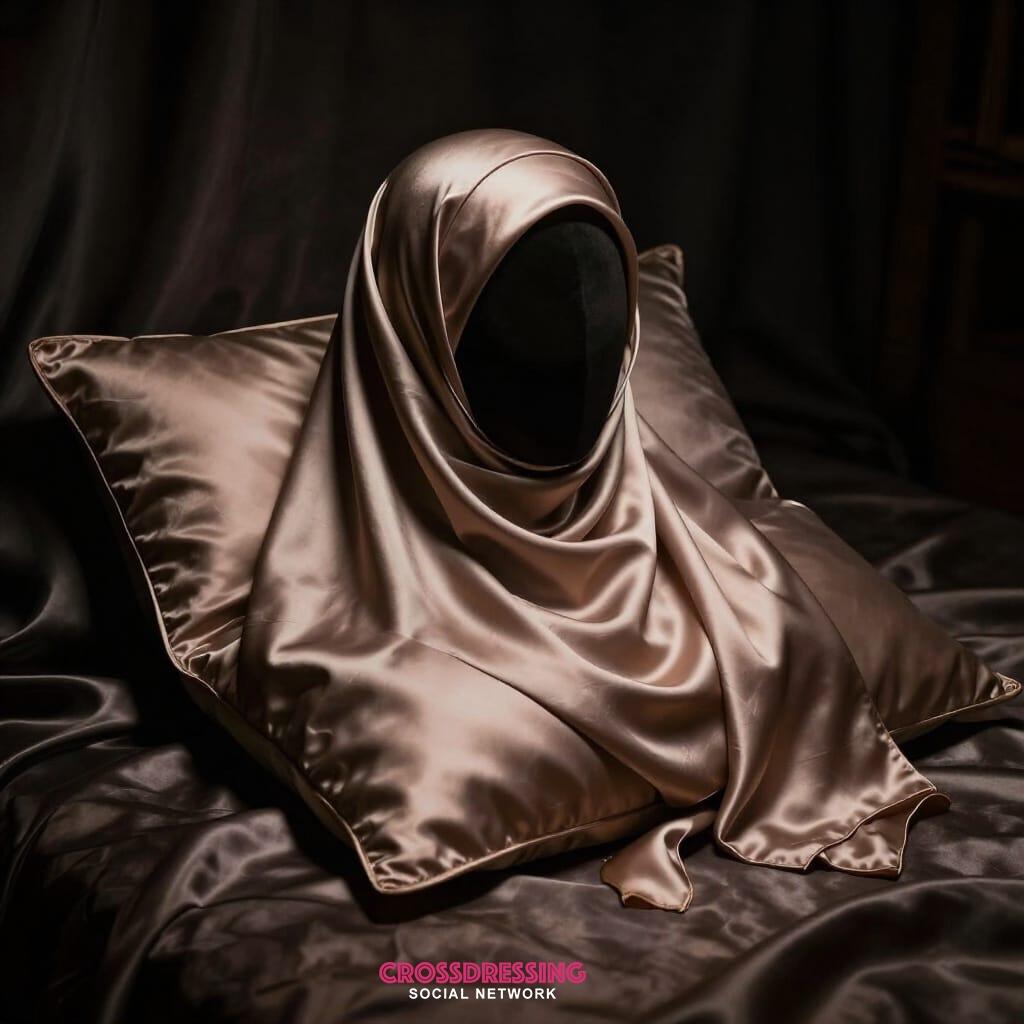
My own outfit tonight is the usual liturgy of satin devotion: full length satin slip beneath a long, bias-cut satin kaftan in the same deep cocoa family, sleeves falling past my knuckles in heavy, liquid folds. Satin gloves to the elbow. Satin socks sliding inside satin lined house slippers. Even the thin belt I tied at the waist is doubled satin cord. I have not worn anything else cotton, wool, denim, polyester in years. Skin has forgotten every texture but this one. There, resting on a perfectly smooth, shimmering brown satin pillow, sits the mannequin headform. Draped across it is the headscarf fresh from its tissue paper cradle only an hour ago. The silk satin is so densely woven, so exquisitely finished, that it looks poured rather than cut and stitched. I approach the mannequin headform with deliberate slowness, my satin gloved fingers trembling just enough to send faint shivers through the fabric. The spotlight above casts a warm, golden halo, making the brown satin headscarf and hijab gleam like polished mahogany. The pillow beneath them is plush, yielding slightly as I lift the scarf first careful, so careful not to crease its pristine folds. It unfolds in my hands like a living thing, cool and heavy, the weave so tight it feels like liquid silk against my palms. I pause, holding it up to the light. The edges are hemmed with invisible stitches, the kind only a master tailor would bother with. No fray, no flaw. Just endless, unbroken sheen. My breath catches as I imagine the transformation ahead the ritual that turns ordinary skin into something exalted, wrapped in satin sanctity. First, the preparation. I glide to the satin draped vanity nearby, where my tools wait: a small satin pouch of pins, each head coated in matching brown mother of pearl, a fine misting bottle of distilled water scented with a hint of vanilla to enhance the fabric's natural luster; and a full length mirror framed in burnished brass, its surface polished to reflect every nuance. I sit on the satin stool, my kaftan pooling around me in soft waves, and begin with my face. A light dusting of translucent powder to mattify the skin no shine but satin's own allowed. Then, the undercap: a simple brown satin skullcap I slip on, smoothing it flat against my scalp until it's seamless, invisible. Now, the headscarf. I fold it diagonally, creating a perfect triangle, the hypotenuse edge aligned with mathematical precision. I drape it over my head, the point falling down my back like a veil of night. The front edge rests just above my eyebrows, cool against my forehead, and I cross the ends under my chin, pulling them taut but not tight enough to hug, to cradle. The hiss of satin on satin is intoxicating, a whisper that echoes in the quiet room. I tie a loose knot at the nape, then tuck and pin the excess fabric into soft pleats, fanning them out like wings. Each pin slides in with a satisfying click, securing the shape without piercing the illusion of fluidity. I stand and turn to the mirror. Already, the transformation stirs: my features soften under the frame, eyes sharper in contrast to the rich brown. But it's incomplete. The hijab waits on the mannequin, its longer lengths beckoning. I retrieve it next, unfolding the rectangular expanse yards of satin, bias cut for drape. This is the heart of the ritual, the layer that envelops and defines. I position it over the headscarf, centering the wide edge along my hairline, letting the bulk cascade down my shoulders and back. The weight is luxurious, grounding, like being swaddled in opulence. I wrap one end across my chest, over the opposite shoulder, then bring the other around to meet it, creating a crossover that hints at modesty but screams indulgence. Pins again strategic, hidden hold the folds in place: one at the temple, another under the chin, a third securing the tail at my back. Adjustments come in waves. I smooth with gloved hands, coaxing out ripples until the surface is flawless, a continuous flow of brown that catches the spotlight in undulating highlights. A spritz from the bottle, just enough to set the sheen without dampening. I step back, then forward, turning side to side. The mirror shows perfection: head to toe in satin, the new pieces blending seamlessly with my kaftan, as if I were carved from a single bolt of fabric. The ritual peaks in movement. I walk the room's perimeter, feeling the hijab sway with each step, the subtle friction of layers building a symphony of sound rustle, slide, sigh. It's meditative, this pacing, a communion with the texture that owns me. No exposed skin, no interruption; just satin encasing, protecting, obsessing. Finally, satisfaction settles. I return to the spotlight's center, the mannequin now bare beside me, its pillow dimpled from absence. The darkness beyond swallows everything else, leaving only this: me, ritually reborn in brown satin, ready for whatever devotion the night demands.
My own outfit tonight is the usual liturgy of satin devotion: full length satin slip beneath a long, bias-cut satin kaftan in the same deep cocoa family, sleeves falling past my knuckles in heavy, liquid folds. Satin gloves to the elbow. Satin socks sliding inside satin lined house slippers. Even the thin belt I tied at the waist is doubled satin cord. I have not worn anything else cotton, wool, denim, polyester in years. Skin has forgotten every texture but this one. There, resting on a perfectly smooth, shimmering brown satin pillow, sits the mannequin headform. Draped across it is the headscarf fresh from its tissue paper cradle only an hour ago. The silk satin is so densely woven, so exquisitely finished, that it looks poured rather than cut and stitched. I approach the mannequin headform with deliberate slowness, my satin gloved fingers trembling just enough to send faint shivers through the fabric. The spotlight above casts a warm, golden halo, making the brown satin headscarf and hijab gleam like polished mahogany. The pillow beneath them is plush, yielding slightly as I lift the scarf first careful, so careful not to crease its pristine folds. It unfolds in my hands like a living thing, cool and heavy, the weave so tight it feels like liquid silk against my palms. I pause, holding it up to the light. The edges are hemmed with invisible stitches, the kind only a master tailor would bother with. No fray, no flaw. Just endless, unbroken sheen. My breath catches as I imagine the transformation ahead the ritual that turns ordinary skin into something exalted, wrapped in satin sanctity. First, the preparation. I glide to the satin draped vanity nearby, where my tools wait: a small satin pouch of pins, each head coated in matching brown mother of pearl, a fine misting bottle of distilled water scented with a hint of vanilla to enhance the fabric's natural luster; and a full length mirror framed in burnished brass, its surface polished to reflect every nuance. I sit on the satin stool, my kaftan pooling around me in soft waves, and begin with my face. A light dusting of translucent powder to mattify the skin no shine but satin's own allowed. Then, the undercap: a simple brown satin skullcap I slip on, smoothing it flat against my scalp until it's seamless, invisible. Now, the headscarf. I fold it diagonally, creating a perfect triangle, the hypotenuse edge aligned with mathematical precision. I drape it over my head, the point falling down my back like a veil of night. The front edge rests just above my eyebrows, cool against my forehead, and I cross the ends under my chin, pulling them taut but not tight enough to hug, to cradle. The hiss of satin on satin is intoxicating, a whisper that echoes in the quiet room. I tie a loose knot at the nape, then tuck and pin the excess fabric into soft pleats, fanning them out like wings. Each pin slides in with a satisfying click, securing the shape without piercing the illusion of fluidity. I stand and turn to the mirror. Already, the transformation stirs: my features soften under the frame, eyes sharper in contrast to the rich brown. But it's incomplete. The hijab waits on the mannequin, its longer lengths beckoning. I retrieve it next, unfolding the rectangular expanse yards of satin, bias cut for drape. This is the heart of the ritual, the layer that envelops and defines. I position it over the headscarf, centering the wide edge along my hairline, letting the bulk cascade down my shoulders and back. The weight is luxurious, grounding, like being swaddled in opulence. I wrap one end across my chest, over the opposite shoulder, then bring the other around to meet it, creating a crossover that hints at modesty but screams indulgence. Pins again strategic, hidden hold the folds in place: one at the temple, another under the chin, a third securing the tail at my back. Adjustments come in waves. I smooth with gloved hands, coaxing out ripples until the surface is flawless, a continuous flow of brown that catches the spotlight in undulating highlights. A spritz from the bottle, just enough to set the sheen without dampening. I step back, then forward, turning side to side. The mirror shows perfection: head to toe in satin, the new pieces blending seamlessly with my kaftan, as if I were carved from a single bolt of fabric. The ritual peaks in movement. I walk the room's perimeter, feeling the hijab sway with each step, the subtle friction of layers building a symphony of sound rustle, slide, sigh. It's meditative, this pacing, a communion with the texture that owns me. No exposed skin, no interruption; just satin encasing, protecting, obsessing. Finally, satisfaction settles. I return to the spotlight's center, the mannequin now bare beside me, its pillow dimpled from absence. The darkness beyond swallows everything else, leaving only this: me, ritually reborn in brown satin, ready for whatever devotion the night demands.



 English
 Arabic
 French
 Spanish
 Portuguese
 Turkish
 Dutch
Dutch
 Italiano
 Russian
 Romaian
 Portuguese (Brazil)
 Greek
Greek