


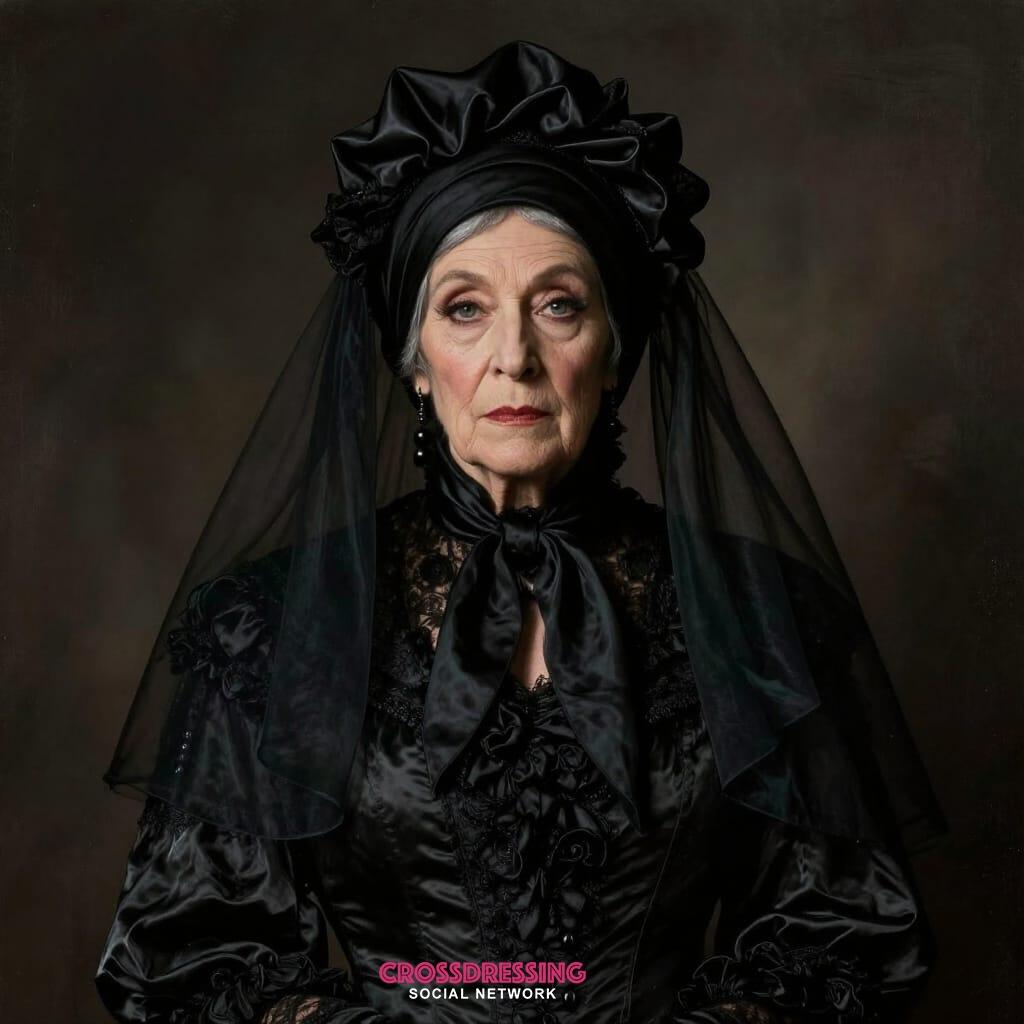
In the dim afternoon light of my bedroom, I sit before the antique dressing table that once belonged to my Wife. The black satin headscarf rests across my lap like spilled ink, its oversized folds still carrying the faint lavender I keep tucked inside the drawer. The veil those fragile layers of sheer black chiffon voile hangs from the wardrobe door, trembling slightly whenever the January wind finds its way through the sash window. Outside, the town lies quiet under the grey sky of the 16th of January 2026.
I run a lace gloved finger along the jet beading on the bodice, the little beads cold at first, then warming as though they remember my body heat. Why this? The question rises again, steady as my own heartbeat. It isn’t only the crossdressing; that word feels too narrow, too modern for what moves through me. This is mourning chosen, worn deliberately, as though putting on these heavy black satins lets me grieve properly, not just for my Wife, but for the version of myself I kept locked away all those years.
I see flashes of the past: my Grandmother’s photograph album, those stern Victorian and Edwardian women in crepe and veils, faces made beautiful by sorrow. I used to stare at them longer than any boy was supposed to, feeling something stir that had no name. Later, during the decades with my Wife, the secret grew in silence satin bought at antique fairs, a chiffon veil ordered late at night from sellers who asked no questions. My Wife never knew, or if she guessed, she let it lie. She would smile when I came home with yet another silk or satin scarf, teasing me about my “fancy tastes,” and I would laugh along, the words both a comfort and a small, private wound. Did I steal something from her by never speaking the truth? Or was the silence kinder, preserving the life we built of Sunday dinners, walks up on the hill across the fields, the kettle whistling in the kitchen while we listened to the afternoon play on Radio 4? The clothes themselves seem to answer me. The satin is cool against my skin at first, then softens, accepts me. It wraps around the shape I carry inside, the one that never quite fitted the name Tony. When I wear it, I become Tonya the widow I sometimes feel I have always been. The mourning isn’t only for my Wife’s death two months ago, it is for all the years I lived half hidden, for the conversations never had, for the evenings I stood alone in front of the mirror trying on fragments of this other life. Out in the town, beneath the veil, the world blurs into gentle greys. People nod with quiet respect, the way they would to any Victorian widow stepping out of time. In those moments the doubt falls away and I feel something close to power, loss made visible, made dramatic, made mine. Yet when I come home and sit here, the questions return. At Sixty Four, is this foolishness or finally honesty? The mirror shows silver hair escaping the satin folds, lines carved by time across my face. Is it too late to become who I have always been inside? Then I remember my Wife’s hand in mine during those last weeks, her voice thin but certain: “Be happy, love. Whatever that looks like.” Perhaps this is what it looks like layers of black satin and chiffon, the headscarf framing my face like a dark halo, the veil softening everything until even my doubts feel bearable. I rise slowly, fold the headscarf with the same care I once used to fold my handkerchiefs after ironing. The reflections will come back tomorrow, and the day after. They are complicated, tangled, sometimes painful. But they are mine, and for the first time I am not afraid to hold them. The wardrobe waits, patient and open. So do I.
I run a lace gloved finger along the jet beading on the bodice, the little beads cold at first, then warming as though they remember my body heat. Why this? The question rises again, steady as my own heartbeat. It isn’t only the crossdressing; that word feels too narrow, too modern for what moves through me. This is mourning chosen, worn deliberately, as though putting on these heavy black satins lets me grieve properly, not just for my Wife, but for the version of myself I kept locked away all those years.
I see flashes of the past: my Grandmother’s photograph album, those stern Victorian and Edwardian women in crepe and veils, faces made beautiful by sorrow. I used to stare at them longer than any boy was supposed to, feeling something stir that had no name. Later, during the decades with my Wife, the secret grew in silence satin bought at antique fairs, a chiffon veil ordered late at night from sellers who asked no questions. My Wife never knew, or if she guessed, she let it lie. She would smile when I came home with yet another silk or satin scarf, teasing me about my “fancy tastes,” and I would laugh along, the words both a comfort and a small, private wound. Did I steal something from her by never speaking the truth? Or was the silence kinder, preserving the life we built of Sunday dinners, walks up on the hill across the fields, the kettle whistling in the kitchen while we listened to the afternoon play on Radio 4? The clothes themselves seem to answer me. The satin is cool against my skin at first, then softens, accepts me. It wraps around the shape I carry inside, the one that never quite fitted the name Tony. When I wear it, I become Tonya the widow I sometimes feel I have always been. The mourning isn’t only for my Wife’s death two months ago, it is for all the years I lived half hidden, for the conversations never had, for the evenings I stood alone in front of the mirror trying on fragments of this other life. Out in the town, beneath the veil, the world blurs into gentle greys. People nod with quiet respect, the way they would to any Victorian widow stepping out of time. In those moments the doubt falls away and I feel something close to power, loss made visible, made dramatic, made mine. Yet when I come home and sit here, the questions return. At Sixty Four, is this foolishness or finally honesty? The mirror shows silver hair escaping the satin folds, lines carved by time across my face. Is it too late to become who I have always been inside? Then I remember my Wife’s hand in mine during those last weeks, her voice thin but certain: “Be happy, love. Whatever that looks like.” Perhaps this is what it looks like layers of black satin and chiffon, the headscarf framing my face like a dark halo, the veil softening everything until even my doubts feel bearable. I rise slowly, fold the headscarf with the same care I once used to fold my handkerchiefs after ironing. The reflections will come back tomorrow, and the day after. They are complicated, tangled, sometimes painful. But they are mine, and for the first time I am not afraid to hold them. The wardrobe waits, patient and open. So do I.
In the dim afternoon light of my bedroom, I sit before the antique dressing table that once belonged to my Wife. The black satin headscarf rests across my lap like spilled ink, its oversized folds still carrying the faint lavender I keep tucked inside the drawer. The veil those fragile layers of sheer black chiffon voile hangs from the wardrobe door, trembling slightly whenever the January wind finds its way through the sash window. Outside, the town lies quiet under the grey sky of the 16th of January 2026.
I run a lace gloved finger along the jet beading on the bodice, the little beads cold at first, then warming as though they remember my body heat. Why this? The question rises again, steady as my own heartbeat. It isn’t only the crossdressing; that word feels too narrow, too modern for what moves through me. This is mourning chosen, worn deliberately, as though putting on these heavy black satins lets me grieve properly, not just for my Wife, but for the version of myself I kept locked away all those years.
I see flashes of the past: my Grandmother’s photograph album, those stern Victorian and Edwardian women in crepe and veils, faces made beautiful by sorrow. I used to stare at them longer than any boy was supposed to, feeling something stir that had no name. Later, during the decades with my Wife, the secret grew in silence satin bought at antique fairs, a chiffon veil ordered late at night from sellers who asked no questions. My Wife never knew, or if she guessed, she let it lie. She would smile when I came home with yet another silk or satin scarf, teasing me about my “fancy tastes,” and I would laugh along, the words both a comfort and a small, private wound. Did I steal something from her by never speaking the truth? Or was the silence kinder, preserving the life we built of Sunday dinners, walks up on the hill across the fields, the kettle whistling in the kitchen while we listened to the afternoon play on Radio 4? The clothes themselves seem to answer me. The satin is cool against my skin at first, then softens, accepts me. It wraps around the shape I carry inside, the one that never quite fitted the name Tony. When I wear it, I become Tonya the widow I sometimes feel I have always been. The mourning isn’t only for my Wife’s death two months ago, it is for all the years I lived half hidden, for the conversations never had, for the evenings I stood alone in front of the mirror trying on fragments of this other life. Out in the town, beneath the veil, the world blurs into gentle greys. People nod with quiet respect, the way they would to any Victorian widow stepping out of time. In those moments the doubt falls away and I feel something close to power, loss made visible, made dramatic, made mine. Yet when I come home and sit here, the questions return. At Sixty Four, is this foolishness or finally honesty? The mirror shows silver hair escaping the satin folds, lines carved by time across my face. Is it too late to become who I have always been inside? Then I remember my Wife’s hand in mine during those last weeks, her voice thin but certain: “Be happy, love. Whatever that looks like.” Perhaps this is what it looks like layers of black satin and chiffon, the headscarf framing my face like a dark halo, the veil softening everything until even my doubts feel bearable. I rise slowly, fold the headscarf with the same care I once used to fold my handkerchiefs after ironing. The reflections will come back tomorrow, and the day after. They are complicated, tangled, sometimes painful. But they are mine, and for the first time I am not afraid to hold them. The wardrobe waits, patient and open. So do I.


 English
 Arabic
 French
 Spanish
 Portuguese
 Deutsch
 Turkish
 Dutch
Dutch
 Russian
 Romaian
 Portuguese (Brazil)
 Greek
Greek