


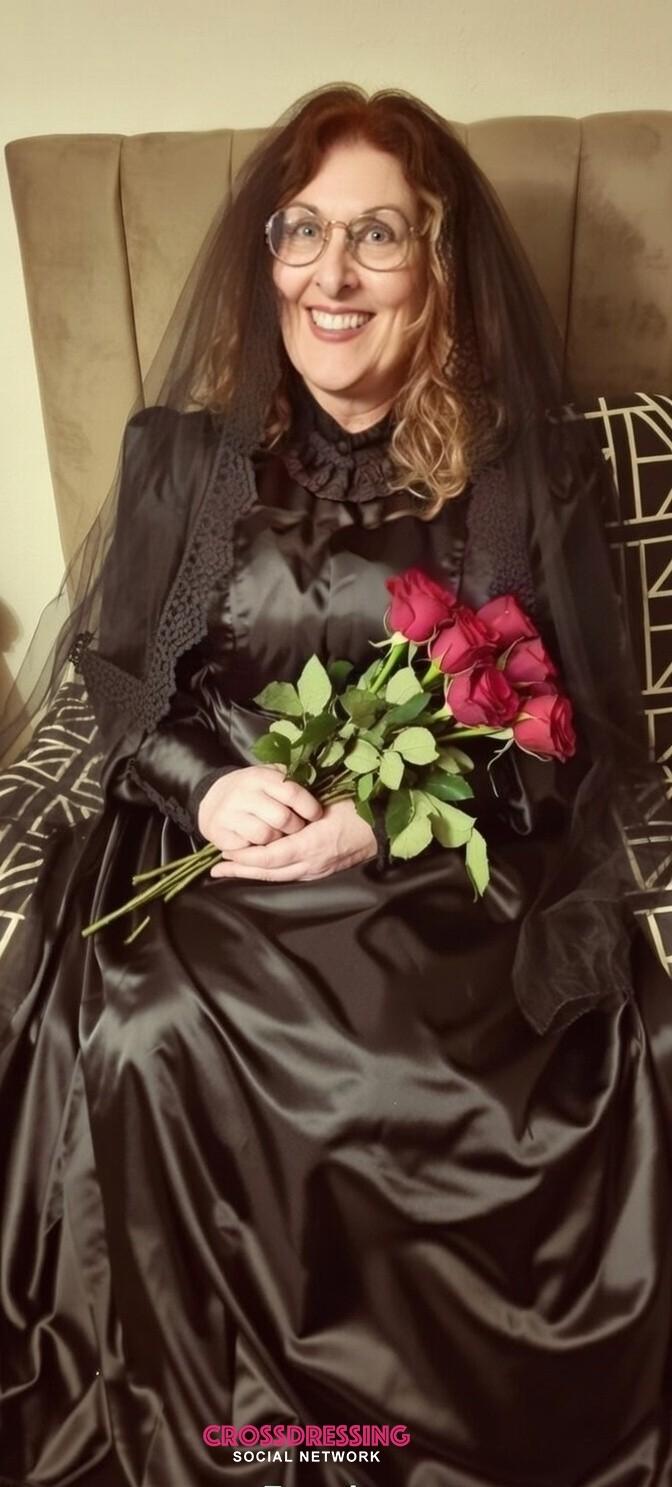
I sit motionless in the dim parlor, the heavy velvet drapes drawn against the January gloom outside. The only light comes from the tall candelabra behind me, its flames trembling as though they, too, are in mourning. My reflection stares back from the tall gilt mirror across the room a stranger wearing my face, yet not quite mine anymore. The black satin gown clings to me like spilled ink, cool and liquid against my skin. Each subtle shift of my body sends faint gleams racing along the fabric, silver whispers in an ocean of midnight. The high collar bites gently at my throat, edged with fragile black lace that looks as though it might crumble if I breathed too deeply. The sleeves are puffed at the shoulders, then narrow cruelly down my arms until the cuffs grip my wrists like velvet manacles. I feel both imprisoned and exalted. The chiffon voile veil floats over my head, so fine it seems spun from smoke. It softens the edges of the world, turns the candlelight into a gentle, diffused halo. Through its haze I can see the portrait painter’s easel, the careful arrangement of shadows he is trying to capture. He keeps glancing at me as though he fears I might vanish if he looks away too long. My lips are painted the colour of old blood left to dry blackened plum, almost truly black in this light. The lipstick feels thick, ceremonial. Each time I press them together I taste the faint metallic bite of the pigment. My eyes are rimmed with kohl so dark it seems to drink the light; the sharp wings of liner make my gaze look both wounded and dangerous, like something beautiful that has learned how to bite. In my hands I cradle the bouquet. Once they were perfect crimson roses, the kind lovers press between the pages of forbidden books. Now they are dying in slow, exquisite agony. The stems bend wearily, heavy with the weight of their own decay. Petals loosen one by one, drifting down like drops of blood onto the polished floorboards. I can hear them fall soft, deliberate sounds, the quiet punctuation of something ending. I do not cry. There are no tears left for what I have become, for the man I buried beneath satin and shadow. This is not grief in the ordinary sense. This is something older, more deliberate a ritual of exquisite surrender. I chose every detail of this costume, every inch of mourning silk, every wilting bloom. I dressed myself for my own funeral, painted my own face for the wake, arranged my own flowers. And now I stand here, perfectly composed, while the painter tries to trap eternity in oil and canvas. Sometimes I think I can hear the roses whispering as they die. They do not beg for water. They do not ask to be saved. They only sigh, petal by petal, accepting their beautiful collapse. And I understand them perfectly. The veil stirs slightly as I exhale. A single crimson petal catches on the sheer fabric, trembling there like a ruby tear that refuses to fall. I do not brush it away. Let it stay. Let it be seen. Let the portrait show exactly what I have chosen to become: A widow of my former self, dressed in the most exquisite grief, holding death’s bouquet with steady, loving hands, smiling just a little behind lips the colour of finality.
I sit motionless in the dim parlor, the heavy velvet drapes drawn against the January gloom outside. The only light comes from the tall candelabra behind me, its flames trembling as though they, too, are in mourning. My reflection stares back from the tall gilt mirror across the room a stranger wearing my face, yet not quite mine anymore. The black satin gown clings to me like spilled ink, cool and liquid against my skin. Each subtle shift of my body sends faint gleams racing along the fabric, silver whispers in an ocean of midnight. The high collar bites gently at my throat, edged with fragile black lace that looks as though it might crumble if I breathed too deeply. The sleeves are puffed at the shoulders, then narrow cruelly down my arms until the cuffs grip my wrists like velvet manacles. I feel both imprisoned and exalted. The chiffon voile veil floats over my head, so fine it seems spun from smoke. It softens the edges of the world, turns the candlelight into a gentle, diffused halo. Through its haze I can see the portrait painter’s easel, the careful arrangement of shadows he is trying to capture. He keeps glancing at me as though he fears I might vanish if he looks away too long. My lips are painted the colour of old blood left to dry blackened plum, almost truly black in this light. The lipstick feels thick, ceremonial. Each time I press them together I taste the faint metallic bite of the pigment. My eyes are rimmed with kohl so dark it seems to drink the light; the sharp wings of liner make my gaze look both wounded and dangerous, like something beautiful that has learned how to bite. In my hands I cradle the bouquet. Once they were perfect crimson roses, the kind lovers press between the pages of forbidden books. Now they are dying in slow, exquisite agony. The stems bend wearily, heavy with the weight of their own decay. Petals loosen one by one, drifting down like drops of blood onto the polished floorboards. I can hear them fall soft, deliberate sounds, the quiet punctuation of something ending. I do not cry. There are no tears left for what I have become, for the man I buried beneath satin and shadow. This is not grief in the ordinary sense. This is something older, more deliberate a ritual of exquisite surrender. I chose every detail of this costume, every inch of mourning silk, every wilting bloom. I dressed myself for my own funeral, painted my own face for the wake, arranged my own flowers. And now I stand here, perfectly composed, while the painter tries to trap eternity in oil and canvas. Sometimes I think I can hear the roses whispering as they die. They do not beg for water. They do not ask to be saved. They only sigh, petal by petal, accepting their beautiful collapse. And I understand them perfectly. The veil stirs slightly as I exhale. A single crimson petal catches on the sheer fabric, trembling there like a ruby tear that refuses to fall. I do not brush it away. Let it stay. Let it be seen. Let the portrait show exactly what I have chosen to become: A widow of my former self, dressed in the most exquisite grief, holding death’s bouquet with steady, loving hands, smiling just a little behind lips the colour of finality.


 English
 Arabic
 French
 Spanish
 Portuguese
 Deutsch
 Turkish
 Dutch
Dutch
 Russian
 Romaian
 Portuguese (Brazil)
 Greek
Greek